
Henderson Projected Versus Actual Dates
A projected date is produced from the sentence and the credits or restrictions that apply at that point. It can move. An actual release date records a completed event. A parole eligibility date only marks when the Board may consider parole, and a court order date can precede jail processing.
Pretrial detainees usually have no sentence-based release date. Their next event can turn on bond, dismissal, a plea, a trial, or a hold from another authority. For a local sentence, HCDC and the Henderson court are the proper sources. For a Kentucky felony sentence, use KOOL.
Find Henderson Inmate Release Dates
KOOL is the Kentucky Department of Corrections lookup. Its advanced form includes “Inmate Release Date From / To,” and person details can show sentence and parole dates.
- Decide whether the person is a pretrial or county inmate, a KDOC prisoner, or held for another agency.
- Search KOOL by last name and first initial for a state case. Use a DOC or PID number when known.
- Match birth details, conviction, photo, and location. Do not rely on name alone.
- Read every date label exactly, including minimum expiration, maximum expiration, parole eligibility, and proposed release.
- Check the court docket and ask HCDC for the computation when the sentence is local or KOOL has no record.
- Check for detainers and confirm the completed event through the Henderson release record.
KOOL is not a booking archive for every misdemeanor or short stay. A state felon may be housed at HCDC while still under KDOC jurisdiction, so physical location alone does not determine which record controls.
Kentucky Credits Change Release Dates
KRS 197.045 governs Kentucky sentence credits. Statutory good time can reduce the maximum term for eligible prisoners. Meritorious good time and program completion credits depend on the statute, agency rules, eligibility, conduct, and documentation. Credits can be forfeited.
No safe public calculation comes from subtracting a flat number from the sentence. Jail credit, aggregated sentences, program completion, disciplinary loss, offense restrictions, detainers, and corrections can change the result. The KDOC sentence-credit regulation provides the administrative framework behind those determinations.
Good-time note: A credit affects sentence computation only when the person and credit qualify under the governing law and KDOC applies it.
The official Kentucky sentence-credit regulation is shown below. Its categories help explain why a projected date can differ from a simple sentence-length estimate.
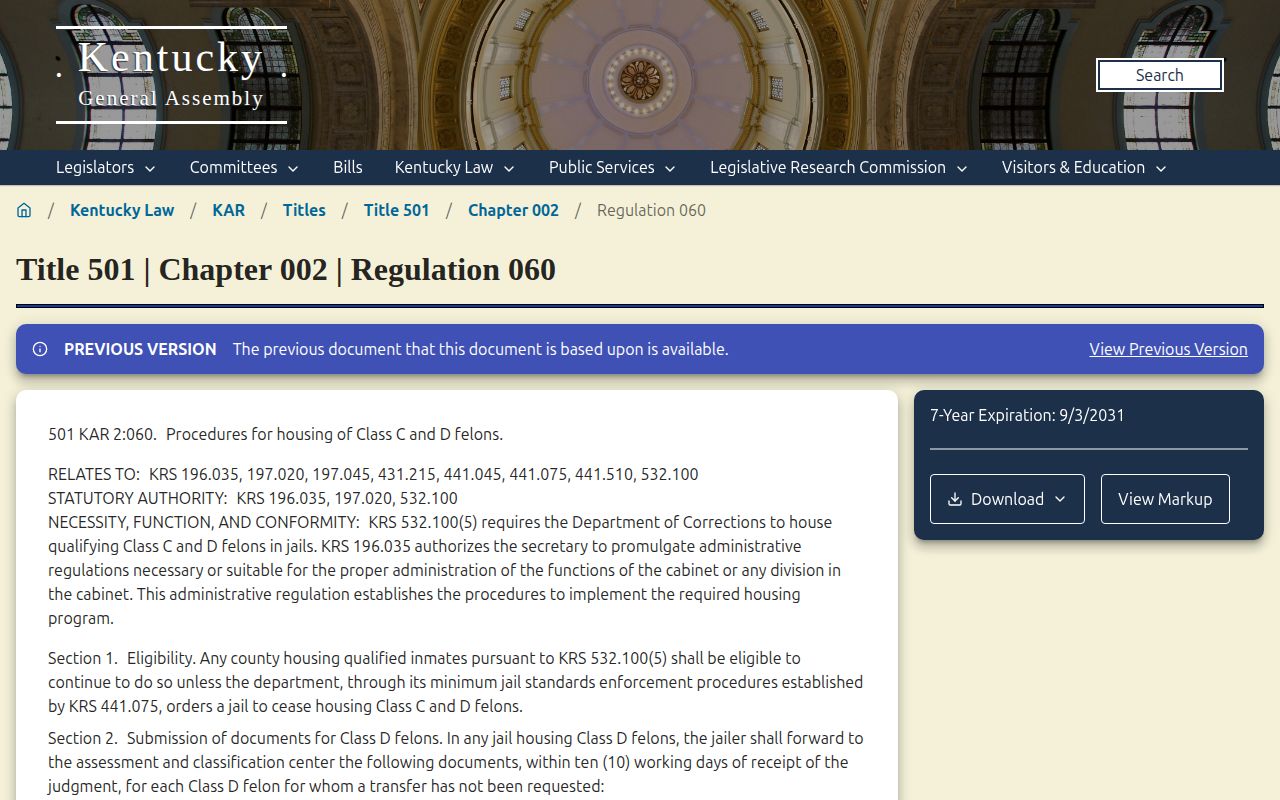
The image is a source view, not a person-specific calculation. Use the inmate’s official KOOL record and sentencing documents for the actual labels.
Why Henderson Release Dates Move
A projected date changes when the inputs or governing event change. Some factors alter sentence computation. Others prevent physical release even if the sentence date arrives.
| Factor | Possible effect | Confirm with |
|---|---|---|
| Credit earned or lost | Moves computed expiration | KDOC sentence detail |
| Detainer or warrant | Transfer or continued custody | Holding and receiving agencies |
| Court correction or new sentence | Changes controlling term | Certified court order |
| Parole action | Creates, defers, or rescinds a possible release path | Parole Board and KOOL |
| Revocation | Returns a supervised person to custody | Court, Board, and KDOC |
A transfer is not community release. Ask for the destination or receiving agency whenever HCDC no longer shows the person.
Confirm Henderson Actual Release
Register through the VINELink release check for a custody event, then verify the event with its originating agency. VINE is a notification service, not the certified record custodian. An alert may arrive after the agency records the event.
For HCDC, request the named booking’s actual release date and time, release type, authority, and destination. For KDOC, compare KOOL status and supervision begin date. A community status such as Parole or Mandatory Reentry Supervision is stronger evidence than an eligibility date alone.
Kentucky’s Violent-Offender Rule
KRS 439.3401 restricts early release for a violent offender within its definition. For covered terms of years, the law generally requires at least 85 percent to be served before listed early-release paths, subject to offense and date provisions. It is not an 85-percent rule for every felony.
The definition changed through legislation, so apply the law in effect for the offense date. Use the person-specific KOOL time-service requirement and the current version of 501 KAR 1:030. Eligibility still does not guarantee release.
The official statute page illustrates the controlling source for this limit. Review KRS 439.3401 before interpreting the screenshot.
The statute must be paired with the judgment, offense date, and KDOC computation rather than applied from an offense name alone.
County Versus State Sentences
KOOL computes dates for people under KDOC jurisdiction, including some state felons housed at HCDC. It does not calculate each Henderson misdemeanor or pretrial stay. For a county sentence, read the judgment, obtain admission credit and the release computation from HCDC, and ask whether another hold exists.
Do not transplant a date from another booking or from a namesake. Keep booking, DOC, PID, and case numbers tied to the source that issued them. Final proof remains the actual release entry or receiving-agency record.
Read Kentucky Date Labels Exactly
A KOOL detail can include minimum expiration, maximum expiration, parole eligibility, supervision begin or end, and proposed release fields. Each answers a different question. Minimum expiration reflects a sentence computation that may include credits. Maximum expiration is another computed endpoint. Parole eligibility marks the first possible consideration point under the applicable rules.
A proposed release date can follow a Parole Board action, but later action or release processing may change it. A supervision begin date paired with a community status is better evidence that incarceration ended. Even then, it does not prove final discharge. Write down the exact field name, date, and the date the public record was checked so later changes can be understood.
Henderson Holds Block Release
HCDC houses a mixed county, state, and federal population. Reaching the end of one local matter may lead to transfer rather than release to the community. Another county warrant, a KDOC transport, a federal hold, or another agency’s detainer can keep custody active after the first authority finishes its part.
Ask HCDC for the release category, authority, and destination or receiving agency. If the record says transfer, follow the person in the receiving system. KOOL is appropriate for KDOC custody, while a federal path may require the Bureau of Prisons locator or confirmation from the U.S. Marshals and HCDC. A missing name on the local roster answers none of these questions by itself.
Parole Is Not a Promise
A parole eligibility date permits consideration; it does not require a favorable decision. Board action can defer review, deny release, recommend release, rescind an earlier action, or require the sentence to be served. The current 501 KAR 1:030 contains date-specific and offense-specific schedules, so an estimate based only on felony class can be wrong.
For contrast, KRS 439.340 includes an earlier review point for some qualifying nonviolent Class D sentences, with exceptions. Mandatory Reentry Supervision under KRS 439.3406 also applies only to eligible people. Neither rule should be turned into a universal release calculator. Use KOOL’s person-specific fields and the judgment.
Request the Actual Henderson Event
When exact timing matters, request the admission-and-release record for the named booking. Include the full name, one disambiguator, the booking number when known, and the approximate admission date. Ask for actual release date and time, release type, authority or order, and destination or receiving agency. Electronic copies are preferred.
Kentucky’s jailer records schedule describes “when discharged” and “by whose order discharged” fields in the closed jail register. It also sets a five-year-after-release retention period for the cumulative inmate file. Retention does not mean every component is open, but it explains why a booking-specific records request can work after a person disappears from the current web list.
Release Alerts Need Verification
Henderson County says offender custody-status notifications remain active through VINE by web, app, and telephone. Its court-date connection was separately reported offline, so use the Kentucky Court of Justice guest portal for the docket. A custody alert and a court event should not be treated as one combined record.
Alerts can lag the agency event. Save the event description, then confirm it with HCDC or KDOC. If the event is transfer, locate the receiving authority. If KOOL changes to Parole or Mandatory Reentry Supervision, verify the supervision begin date and office before stating that prison custody ended.
Henderson Court Dates and Release
The court docket explains why custody may change, but it is not a gate log. A bond order, dismissal, judgment, sentence, probation order, or revocation can authorize or explain movement. Staff still need time to check holds, calculate credit, complete paperwork, and process property. Therefore the time an order is signed may differ from the actual HCDC release time.
Search the Kentucky Court of Justice guest portal for the Henderson case and read entries chronologically. Use the case number to request a copy of the controlling order from the Circuit Court Clerk. Then obtain the HCDC admission-and-release entry when the actual date, time, type, or destination matters. This two-source check is especially useful for county sentences that never appear in KOOL.
Bond release is conditional release under court authority. It is not proof of sentence completion. Henderson’s current jail warning also says cash bonds only and warns against telephone or online payment demands. Official pages conflict on some posting hours, so call HCDC or the Circuit Court Clerk before traveling or paying.
Keep Henderson Dates Current
Record the date each source was checked. Public status can change after a new court order, disciplinary decision, recalculation, Board action, or transfer. A screenshot without its observation date can look more certain than it is. Recheck near the projected day and again after any expected release event.
If exact proof is needed, preserve the official response rather than relying on a copied date. Ask the custodian to identify the label and record source. This keeps a projected sentence field separate from the actual release entry and from any later final-discharge record.
When two official sources show different dates, do not choose the earlier one. Check whether one is an eligibility date, one is an expiration date, or one reflects a newer order. Contact the authority that owns the controlling sentence computation and record its explanation. The actual release entry remains the final event evidence.